Vernissage: Friday, 10 April, 18:00 - until late
The Electric Slide is an essential entry into the American line dance canon. You bop, tap, turn and hit reverse in tandem with friends and family, improvising when you’re feeling it. This show exudes that same exuberance of individual moves conducted by a collectively felt rhythm.
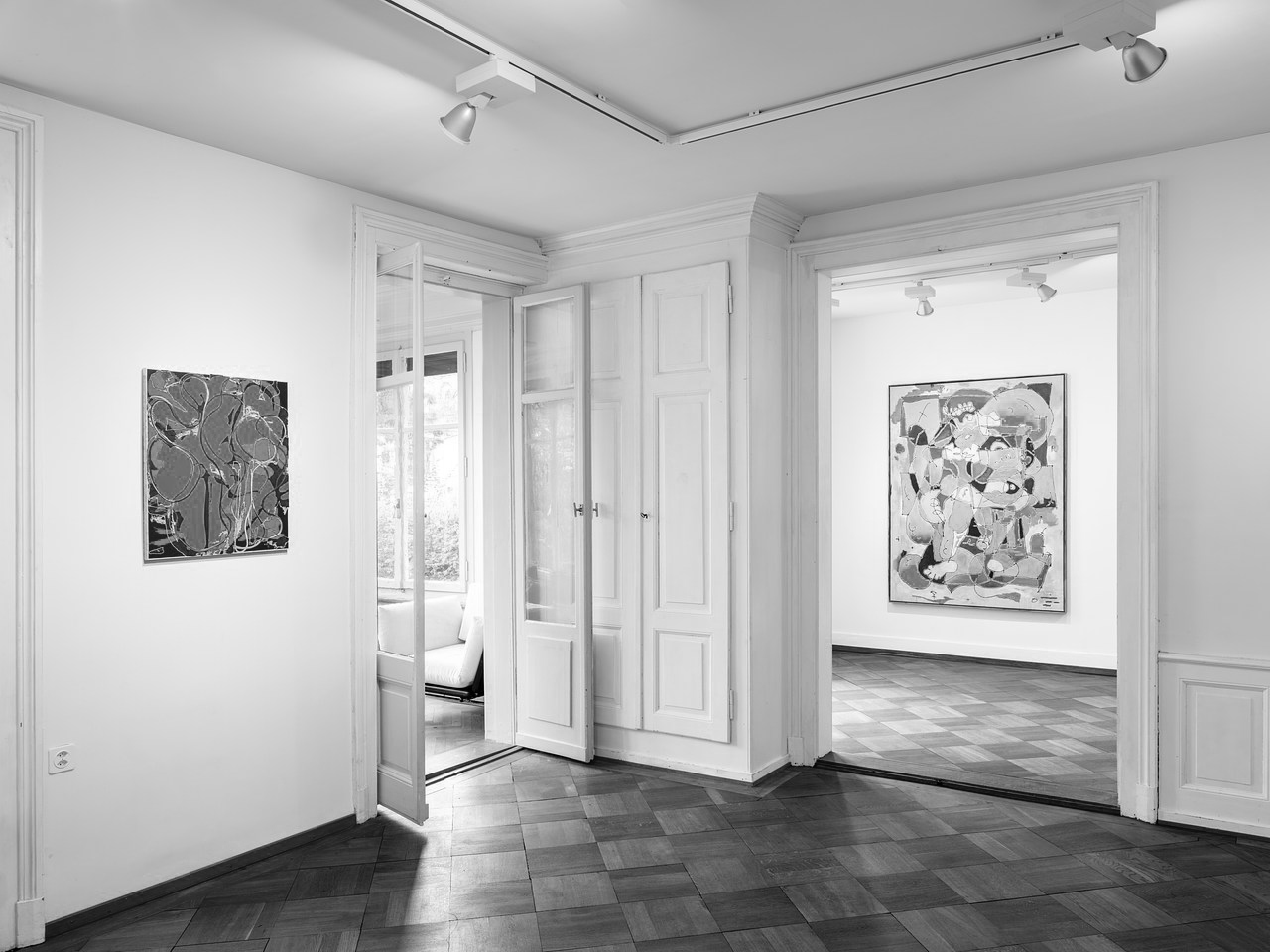
Tunji Adeniyi-Jones, Uli Okujeni, and Zak Prekop each employ articulate, conspicuous lines in their paintings - that’s the rhythm - finessing them so that they can both couple with and delineate the technicolors with which they reside. The lines are so wily, and the colors, so sincere; these are three meticulous artists who want to thrill and be thrilled in return.
Tunji’s work is steady and sensuous. A bodacious line describes a leaf, then goes on to compose a sleek and slender being. After that, it might slim until it vanishes into the bright color it was once atop. There is a sureness of trajectory here - less Newtonian physics than the parabolic curves that emerge because his body is so close to his hand - lest something out of his sight throw it off of its charted course. As compositions they reference a blend of Black Aesthetic Traditions he’s experienced in his lives between the UK, the US, and Nigeria. There is an organic thread running through the works: the ever present almost-people, the leaves and the flowers, the generative rhythm of Adeniyi-Jones’ flows of color, and the entanglement of figure and ground. Mythical creatures in motion emerge, straight from the Ancients, and freed from the Futurist’s clutches.
Zak’s lines resemble an electron’s random walk, steered by current and resistance. They finely slice into modules his neon-colored tableaus, sometimes embodying the word ‘zap’ in a cartoon and other times the zig zags of a seismograph. Their densities change course unceremoniously and simply could not be identical to the next one. Some are thin, jagged, and rendered with a palette knife in simple black or white. Yet that same line might quickly become elliptical and wide enough to be able to contain its own reds or pinks or blues. While clearly demarcating the edges of each piece of the painting, they so snugly bring them together that they seem as if they might burst from the picture plane. These are brash and tender paintings, made with patience and a chaotic streak.
Uli’s lines feel comparatively leisurely; they have no chores on their agenda. Their decisive imprecision gives the impression of a slower yet assured pace. They mosey along but don’t meander, knowing exactly where they are headed. Between the line itself and the color field it borders are a few millimeters of blank space, permitting both the colors and the lines to harmoniously flourish because of the extra legroom. The colors in each distinctive area are sometimes matter-of-fact, sometimes ombré, and sometimes not strictly contained, generously allowed to share space with others. The way Uli combines the composition’s unstressed outlines and trippy colors calls on 2000s Cartoon Network animation or Robert Colescott should he have leaned into abstraction. In process, they begin as sort-of figurative watercolor studies and morph into delightfully and cleverly busy paintings.
Adeniyi-Jones’, Okujeni’s, and Prekop’s paintings can be received as a good optical illusion, wherein the eye and brain zoom in and out trying to comprehend a pattern. Yet, they remain in limbo, suspended between a persistent and entrancing big picture and the examination of the individual moves that constitute it; as if by magic.
All present inextricable symbioses between form, atmosphere, subject, and color. As such, this show also unites a funky mix of foremothers and -fathers. Barnett Newman is here, having used linework to tease out the other material aspects of the painting. Lee Krasner is too, with her breezy, full color abstractions wherein lines exist and then don’t. And a blessing from Julie Mehretu, whose lines and color fields get lost in one another.
A line dance demands you fall in line, but relies on you to feel free to dance out of line, so to speak, when the spirits of your ancestors grab you, and want to take you for a spin.